Surveillance Of Recurrence and Second Cancer
The 5-year survival rate for patients who have undergone curative resection for localized disease (Stage I) is 90%, this decreases to around 65% when metastasis to regional lymph nodes (Stage III) is detected (Jemal et al., 2003). The majority of recurrences occur within the first 3 years after surgical resection of the primary tumor and around 95% in the first 5 years (Engstrom et al., 2003a, 2003b; Goldberg et al., 1998). The most common sites of recurrence are the liver, lungs, and locoregional. The main goal of surveillance is to improve overall survival by detecting recurrences in the asymptomatic stage when radical surgical treatment could still be a viable option. Other potential benefits include the identification of metachronous colorectal cancers, monitoring outcomes, psychological support, and identifying treatment complications and related medical issues. Controversies exist regarding the diagnostic tests, the timing of these tests, and the necessity of a follow-up. A combination of modalities is commonly used including physical examination, carcinoembryonic antigen (CEA) level, liver sonography, colonoscopy, proctosigmoidoscopy/endoanal ultrasound (rectal cancer), computed tomography (CT), magnetic resonance imaging, positron emission tomography (PET) scan, and chest X-ray.
Goals of Surveillance (Haria et al., 2021; Makhoul et al., 2015)
1. Early Detection of Recurrence: The primary goal is to identify recurrences (cancer returning after treatment) as early as possible, ideally before symptoms appear.
2. Detection of Second Primary Cancers: Surveillance also aims to find new, unrelated colorectal cancers that develop in the same patient. The purpose of surveillance is twofold: to detect local or metastatic recurrence and to catch metachronous neoplastic colorectal lesions, which have a higher incidence in these patients.
3. Improved Survival: Early detection of recurrence or second cancers can lead to timely interventions, potentially improving survival rates.
4. Psychological Support: Regular monitoring provides reassurance and support to patients during their survivorship period.
5. Monitoring Treatment Complications: Surveillance can also help identify and manage any complications arising from previous cancer treatments.
Surveillance Methods:
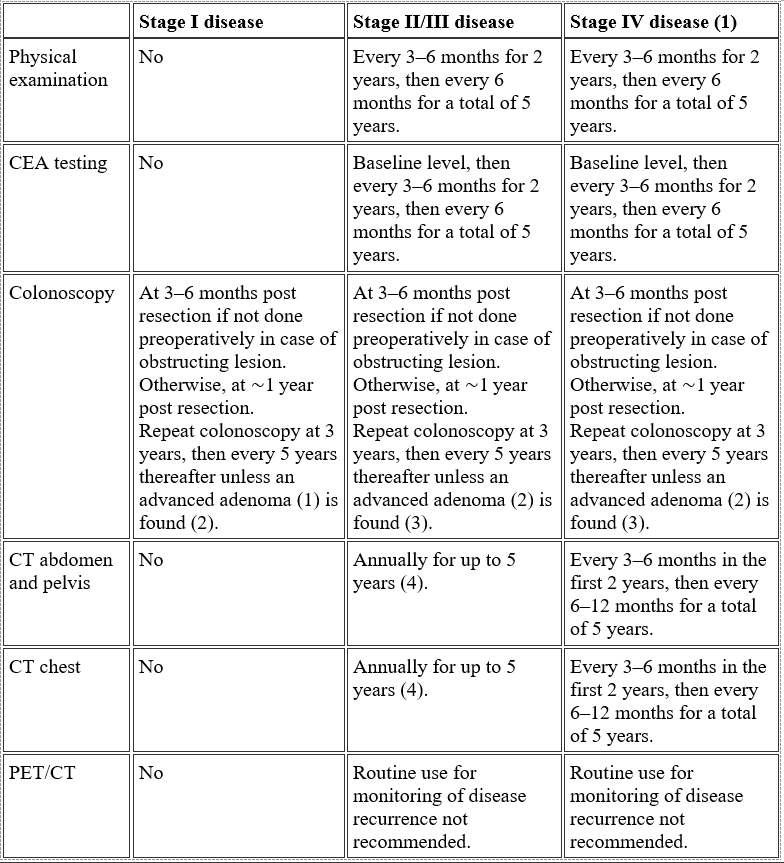
National comprehensive cancer network (NCCN) guideline (Makhoul et al., 2015)
Abbreviations: CEA, carcinoembryonic antigen; CT, computed tomography; PET, positron emission tomography.
Notes: (1) With no evidence of disease post resection and adjuvant chemotherapy.
(2) Advanced adenoma: villous polyp, polyp > 1 cm, or high-grade dysplasia.
(3) Colonoscopy should be repeated in 1 year.
(4) Stage II and III disease with high risk of recurrence.
Frequency of Surveillance (Haria et al., 2021):
The incidence of recurrent disease is ~50% following curative resection of primary colorectal cancer with 71% of recurrences occurring in the first 2 years following resection and 91% by 5 years.35 It is for this reason that most follow-up studies have conducted frequent tests during the first 2 to 3 years with less frequent tests for years 4 and 5. The majority of screening strategies for recurrent colorectal cancer do not extend beyond 5 years. The incidence of a second colorectal cancer primary, however, occurs at a constant cumulative rate of ~3% every 6 years36 and, as such, screening tests must be done at regularly spaced intervals for life.
Importance of Following Recommendations (Doyle, 2016):
1. Consult with your Doctor: Patients should discuss their individual surveillance plan with their oncologist or healthcare team.
2. Adhere to Recommendations: Following the recommended surveillance schedule is crucial for maximizing the chances of early detection and successful treatment.
Sign of Surveillance of Recurrence and Second Cancer
What are the Risk Factors for Recurrence?
Unfortunately, there is no guaranteed way to prevent a recurrence. However, if you have already undergone colorectal cancer treatment, it is important to be aware of the factors that might increase your risk of developing the disease again. Risk factors associated with recurrent colorectal cancer include:
Stage and grade of the original cancer: Later-stage colorectal cancers are more likely to recur than those diagnosed at an earlier stage.
Incomplete surgical margins: If cancer cells remain at the edges of the removed tissue (margin), it could impact the risk of recurrence.
Genetics: Hereditary syndromes, such as Lynch syndrome, familial adenomatous polyposis, or other genetic factors, can influence the likelihood of colorectal cancer recurrence.
Lifestyle and health considerations: Being overweight and having unhealthy dietary habits — such as a diet high in processed meats, refined grains, and added sugars — are linked to recurrence.
Common Signs and Symptoms of Recurrence
Typically, recurrence symptoms are similar to those that can be experienced before the initial diagnosis, which may include:
· Abdominal pain or discomfort
· Change in bowel habits, such as constipation and diarrhea
· Bloody stools
· Rectal bleeding
· Feeling like you still need to have a bowel movement after you just finished
· Fatigue
· Unexplained weight loss
Don’t ignore any of these. Talk with the cancer care team as soon as possible if you notice symptoms. It’s also possible for the cancer to start growing with no physical signs. That’s why follow-up screening colonoscopies are extremely important for colon and rectal cancer survivors.
How Does the Oncologist Know If and Where Colorectal Cancer Has Recurred?
A recurrence is usually detected when symptoms associated with colorectal cancer occur, or during a routine follow-up colonoscopy. This is why it is important to stay vigilant with regular screenings and follow-up appointments with your colorectal cancer care team.
After treatment, your oncologist will monitor you closely, generally through follow-up visits every 3 to 6 months for the first two to three years, and then every six months until you reach the five-year mark. During this time, monitoring may include physical exams, colonoscopies, CEA blood tests, and imaging scans to check for any signs of recurrence.
The earlier a recurrence is diagnosed, the better the chances for successful treatment and survival.
Types of Colorectal Cancer Recurrence
A recurrence may occur in the same location as the original tumor or somewhere else in the body. Your oncologist will explain which type of recurrence you have:
· Local recurrence: This means the cancer has returned to the same area where the original tumor was removed.
· Regional recurrence: This refers to cancer that has spread to nearby lymph nodes but not to other areas of the body.
· Distant recurrence: This describes cancer that has spread (metastasized) outside of the original site to areas such as the liver, lungs, brain, or distant lymph nodes.
Doyle, C. (2016). Surveillance for Recurrence and Second Cancers: Guidelines and Caveats. The ASCO Post. Retrieved February 25, 2016 from
Engstrom, P. F., Benson III, A. B., Choti, M. A., Doroshow, J. H., Enke, C. A., Fuchs, C., Helm, J., Kiel, K., Ludwig, K., & Martin Jr, E. W. (2003a). Colon cancer: clinical practice guidelines in oncology. Journal of the National Comprehensive Cancer Network: JNCCN, 1(1), 40.
Engstrom, P. F., Benson III, A. B., Choti, M. A., Doroshow, J. H., Enke, C. A., Fuchs, C., Helm, J., Kiel, K., Ludwig, K., & Martin Jr, E. W. (2003b). Rectal Cancer: Clinical Practice Guidelines in Oncology. Journal of the National Comprehensive Cancer Network: JNCCN, 1(1), 54.
Goldberg, R. M., Fleming, T. R., Tangen, C. M., Moertel, C. G., Macdonald, J. S., Haller, D. G., & Laurie, J. A. (1998). Surgery for recurrent colon cancer: strategies for identifying resectable recurrence and success rates after resection. Annals of internal medicine, 129(1), 27-35.
Haria, P. D., Baheti, A. D., Palsetia, D., Ankathi, S. K., Choudhari, A., Guha, A., Saklani, A., & Sinha, R. (2021). Follow-up of colorectal cancer and patterns of recurrence. Clinical Radiology, 76(12), 908-915. https://doi.org/https://doi.org/10.1016/j.crad.2021.07.016
Jemal, A., Murray, T., Samuels, A., Ghafoor, A., Ward, E., & Thun, M. J. (2003). Cancer statistics, 2003. CA: a cancer journal for clinicians, 53(1), 5-26.
Makhoul, R., Alva, S., & Wilkins, K. B. (2015). Surveillance and Survivorship after Treatment for Colon Cancer. Clin Colon Rectal Surg, 28(4), 262-270. https://doi.org/10.1055/s-0035-1564435